
Burglary in Harrow: The Local Picture, and How to Protect Your Home
Short answer: Harrow sees roughly 2,200 residential burglaries a year, a rate of about 4.4 per 1,000 residents, which is actually the lowest of the five London boroughs I cover, and it is falling (down about 2.4% year on year). Most break-ins happen on a weekday evening, and the front door is the way in far more often than people expect. The good news: the single biggest fix costs less than a night out. Here are the real numbers, and what actually works.
I’m Andrew, a locksmith based in Rayners Lane. I get called to a handful of after-burglary jobs across Harrow and the surrounding areas every month, so I see the aftermath first-hand. This page isn’t here to scare you. The numbers are genuinely heading the right way. It’s here to show you where the real risk is, and the cheap, boring fix that stops most of it.
How common is burglary in Harrow?
Harrow is not a burglary hotspot. In the year to November 2025 there were around 2,200 residential burglaries across the borough, about 4.4 for every 1,000 residents, and that figure has come down on the year before. For comparison, across the whole of England and Wales there are roughly 450 home burglaries a day, and burglary has fallen by more than 70% since the early 2000s.
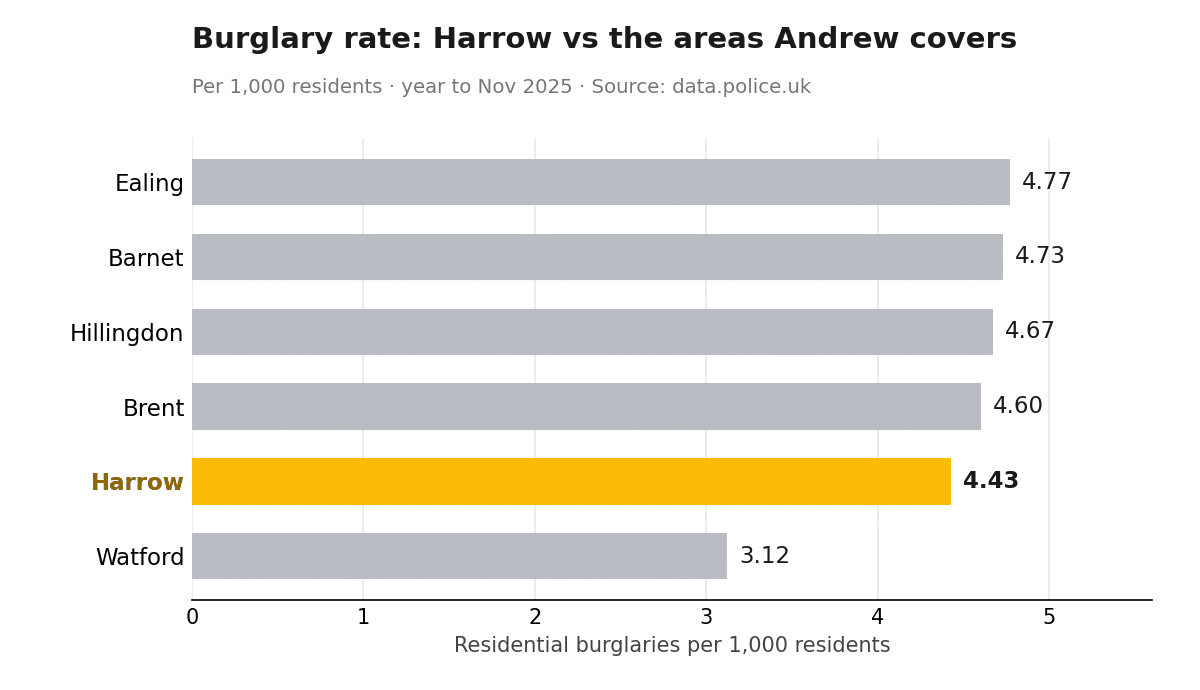
Here is how Harrow sits against the other areas I cover:
| Area | Burglary rate (per 1,000 residents) |
|---|---|
| Ealing | 4.77 |
| Barnet | 4.73 |
| Hillingdon | 4.67 |
| Brent | 4.60 |
| Harrow | 4.43 |
| Watford | 3.12 |
(Year to Nov 2025. Source: data.police.uk. Watford sits in Hertfordshire, which runs lower than the London boroughs.)
So if you live in Harrow, you’re statistically a little safer than your neighbours in Ealing, Barnet or Brent. But “lower than average” isn’t “zero”. It still happens most weeks, and it’s almost always avoidable.
When do break-ins actually happen?
Forget the image of a masked burglar climbing through a window at 3am. The data, and my own callouts tell a different story.
Nationally, around 70% of burglaries happen on a weekday, and the latest figures show about 70% now happen in the evening or overnight rather than in daylight, a share that has actually grown in the last year. That matches exactly what I see locally: the jobs I get called to cluster in the early evening, roughly 7–9pm, not the dead of night. Dark evenings, nobody home yet or settled in front of the telly, curtains open, lights off.
It’s also seasonal. The risk climbs through the darker winter months, when a burglar can tell at a glance which houses are empty. A light left on a timer genuinely earns its keep between October and February.
How do they get in?
This is the part most people get wrong. It’s not windows, and it’s not force through a solid wall. It’s the door. Across England and Wales, 77% of burglars get in through a door, and the front door is the single most common entry point (around two-thirds of cases), well ahead of the back door.
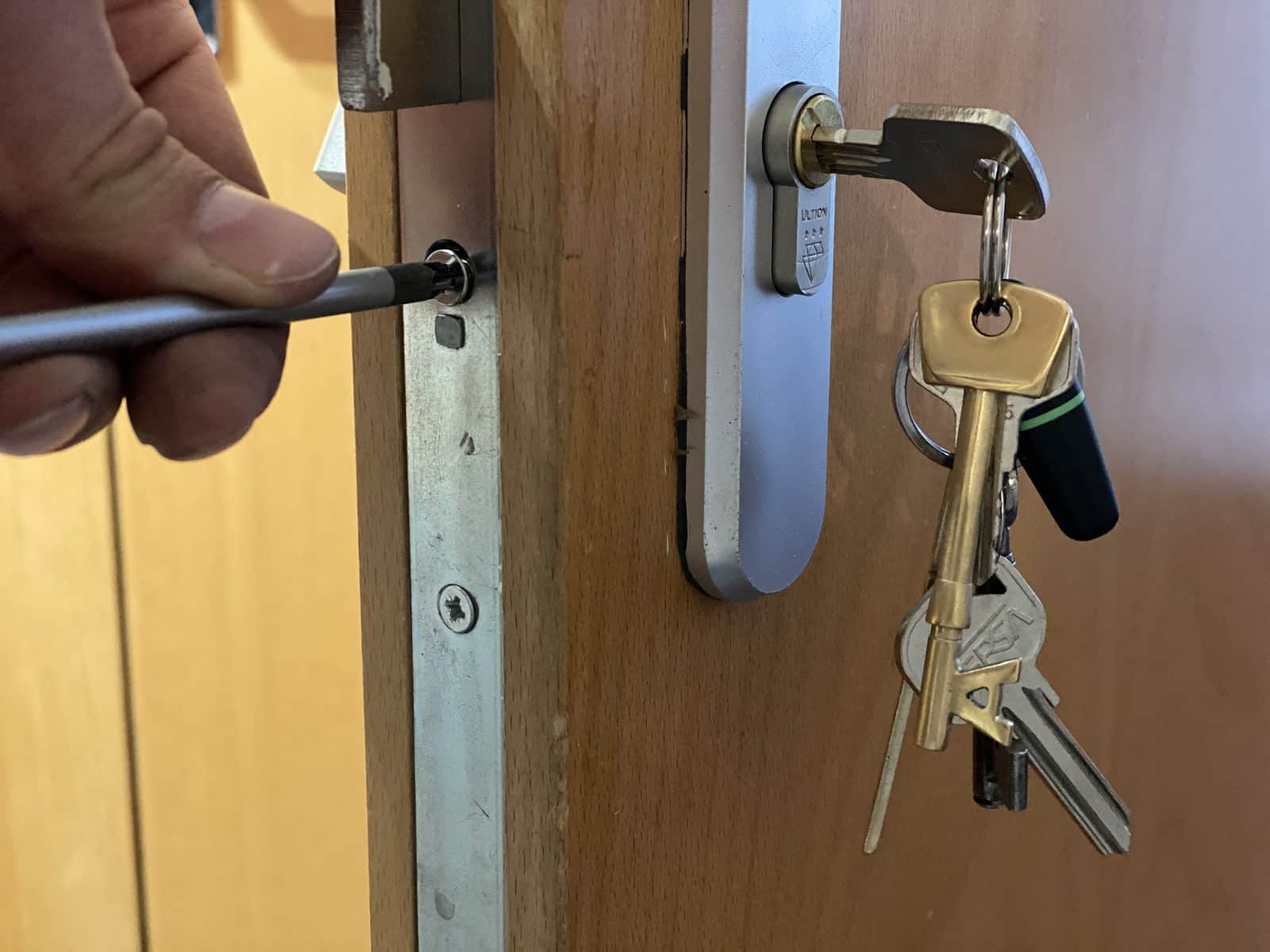
On uPVC and composite doors, the weak spot is the euro cylinder, the lock the key goes into. A basic cylinder can be snapped in around 25 seconds with a cheap tool, exposing the mechanism so it can be turned and the door opened. No noise, no smashed glass, no skill. Most of my after-burglary jobs in Harrow are exactly this: a snapped cylinder on a front or side door while the owners were out. (I’ve written up how snapping works and how to stop it here: What is lock snapping?)
And occasionally it’s even simpler. The scariest job I’ve been to: a family sat watching TV in the evening, front door on the latch but not double-locked. Someone opened it, lifted the car keys off the side, and drove off, the whole thing over in under a minute, with people in the house. One case, thankfully rare, but a reminder that a door that isn’t properly locked isn’t locked at all.
How to protect your home
You don’t need an alarm system or a fortune. The fixes that actually move the numbers are cheap and dull, which is exactly why they work.
1. Upgrade to an anti-snap cylinder. This is the big one. If you’ve got a uPVC or composite door with a standard euro cylinder, swapping it for one rated to TS007 3-star or Sold Secure Diamond (SS312) is the most cost-effective security upgrade you can make. And it’s not just my opinion: after these anti-snap standards arrived (Sold Secure Diamond in 2011, TS007 in 2012–13), recorded lock snapping fell from about a quarter of burglaries at its peak to under 10%. The police forces that saw the worst of it now actively tell people to fit these. See my lock change page.
2. Actually double-lock the door. On a uPVC door, lift the handle and turn the key, a handle-up-but-unlocked door can be forced in seconds, and a latch-only door can just be opened. It costs nothing and it’s the mistake I see most.
3. Layer it up. The research is striking here: homes with a proper combination of security (window locks, deadlocks or double-locked doors, indoor timer lights and external sensor lights) are up to 50 times less likely to be burgled than homes with none. Not 50%. Fifty times. And every bit of the long-term burglary drop has been in forced entries, which is exactly what good locks prevent. A little goes a very long way. My additional security page covers the sensible extras.
If you’re not sure where your home’s weak points are, I do a free, no-pressure security check. I’ll tell you honestly what’s worth doing and what isn’t. And if the worst has already happened, my after-burglary service makes you secure the same visit.
Sources
- Local burglary figures: data.police.uk (Metropolitan Police / Hertfordshire Constabulary), year to Nov 2025.
- National figures on timing and entry method: Office for National Statistics, “Nature of crime: burglary” and “Overview of burglary and other household theft, England & Wales.”
- Evidence on security and the burglary drop: Tseloni, Thompson, Grove, Tilley & Farrell, “Domestic burglary drop and the security hypothesis,” Crime Science (2017); West Yorkshire Police FOI on lock-snapping trends.