
What Should You Put in a Stiff Lock? Usually, Nothing
 Nothing. That is the honest answer and it catches people out every time.
Almost every lock I take out of a box and fit to a door has nothing in it. No grease, no oil, no graphite, nothing at all. It goes on the door dry, it works perfectly, and it carries on working perfectly for years. So if your lock has gone stiff, ask the obvious question first: it did not need lock lubricant when it was new, so why would it need it now?
It does not. Something else has changed. The oil only hides it.
The lady in Queensbury who kept pouring
I got called out to a house in Queensbury. uPVC front door, multipoint mechanism, the sort with the hooks and rollers running up and down the edge of the door. She told me on the phone that it had been getting harder to lock for months and now it would not move at all.
I could smell it before I could see it.
She had been putting cooking oil in the lock. Not a drop on a cotton bud. Bottle poured, straight down the edge of the door and into the mechanism. And here is the part that turned a small job into a whole new mechanism: the stiffer it got, the more she poured. Every time it got worse, she assumed she had not used enough.
By the time I had it apart, everything inside was glued together. Cooking oil goes tacky, then it goes solid, and on the way it collects every bit of dust and grit in that door. There was nothing to clean and nothing to free off. The parts were not dirty, they were bonded to each other. I replaced the whole unit, mechanism and cylinder both. There was no saving it.
So my advice is this: if you are going to put cooking oil in your lock, use extra virgin olive. I want to be very clear that I am joking.
It was not funny for her, though. She paid for a complete door mechanism because of a bottle from the kitchen cupboard. And I have thought about that job a lot since, because she was not being daft. She did exactly what the internet told her to do. Every page she would have found says a stiff lock needs lubricating. She just reached for the wrong bottle.
That is why I am writing this one differently to everybody else.
Your lock came out of the box with nothing in it
Next time you buy a lock, open the box and have a proper look before it goes anywhere near the door. A euro cylinder, a mortice lock, a multipoint strip. They come dry. Have a smell of one. There is nothing to smell.
That is not the manufacturer being tight. It is deliberate. The parts inside a lock are machined to fit each other, and in normal use they move slowly, a few times a day, for a couple of seconds at a time, with almost nothing pushing back against them. A lock is not an engine. It is not spinning thousands of times a minute with heat and load on it, so it does not need a film of oil between the parts to survive.
There is one exception, and it is the important one. A lock only takes real load when somebody is forcing the handle. And that is never the lock’s doing. That is an alignment problem: the door has moved, the hooks are not finding the keeps cleanly, and you are making up the difference with your arm. The mechanism was never built to be shoved.
Which is exactly why the lock feels like the thing going wrong. It is the part you have your hand on. It is not the part that changed.
Which means a lock is not a thing that runs on lubricant and gradually runs out. It is a thing that works dry, and keeps working dry, until something gets in its way.
I would rather you knew that than sold you a tin of something.
And I am not talking in theory. I have had cylinders and multipoint mechanisms apart that were twenty and thirty years old and had never been oiled. Not once. Never. Still working fine, all of them.
What had changed on those doors was not the lock. The door had moved. Sometimes the building itself had moved, which is the sort of thing that happens quietly over thirty years and never announces itself. That, and not the lack of oil, was why the door would not lock.
Lubricated it and it is still not right? Go and look at the wall
Here is something you can do this minute, before you buy anything at all.
You have oiled the lock, or sprayed it, or both, and the door is still fighting you. Go and stand in front of it and look at the wall around the frame. Is there a crack in it?
If there is, you may have just found your problem, and it was never in the lock. Walls do not crack for nothing. Something has moved, and if it moved enough to split the plaster, it moved enough to take your keeps out of line with your hooks.
For the question you came here with, that tells you everything. The lock is the last thing in that chain, not the first. And nothing out of a can is going to argue with a building.
The one I went to the morning after I wrote this
I finished writing the section above one evening. My first job the next morning was this.
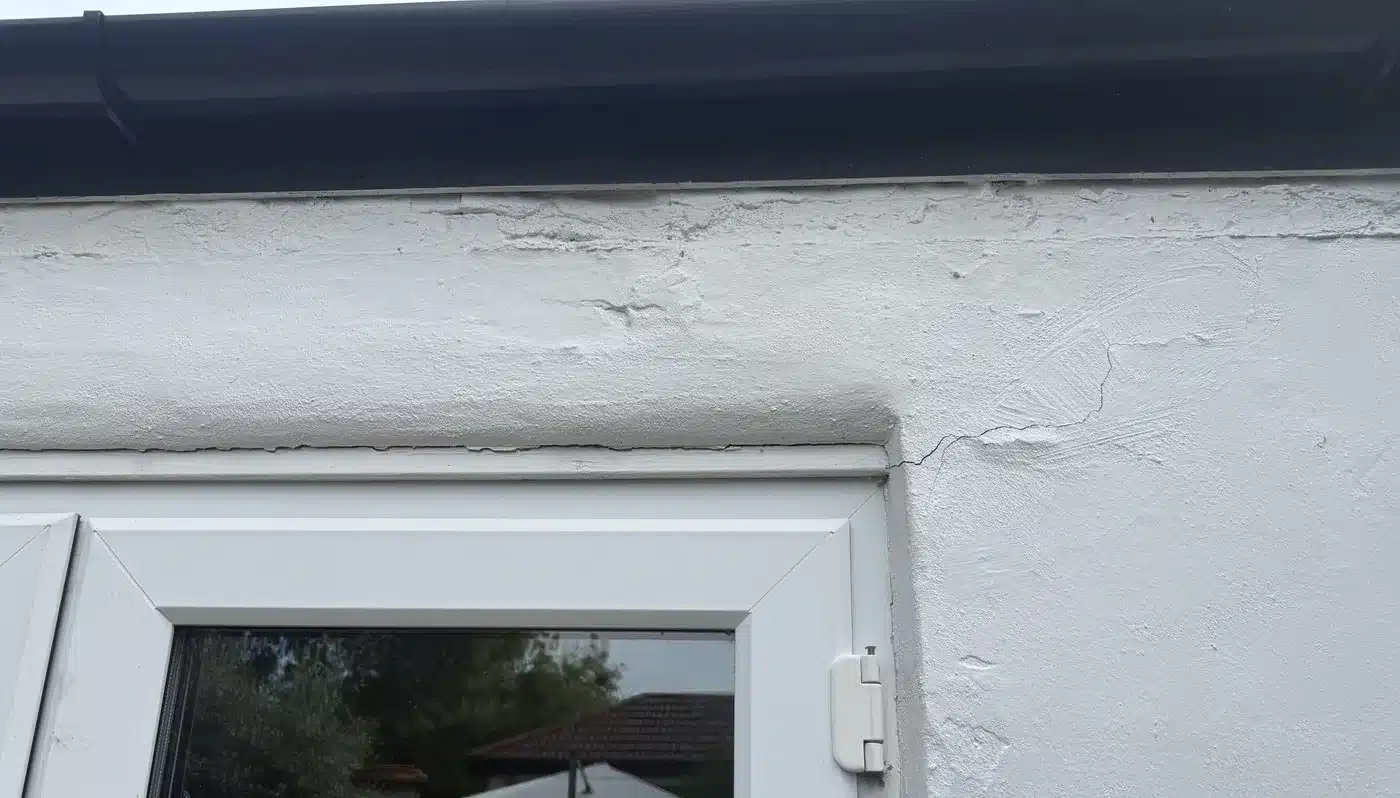
Single storey extension on the back of a house in Belmont, French doors out to the garden, and the wall above them had opened up exactly the way I have just described. You can see it running out of the top corner of the door and away to the right, and along the head of the frame. The extension had moved.
Here is what that movement had done to the doors themselves.
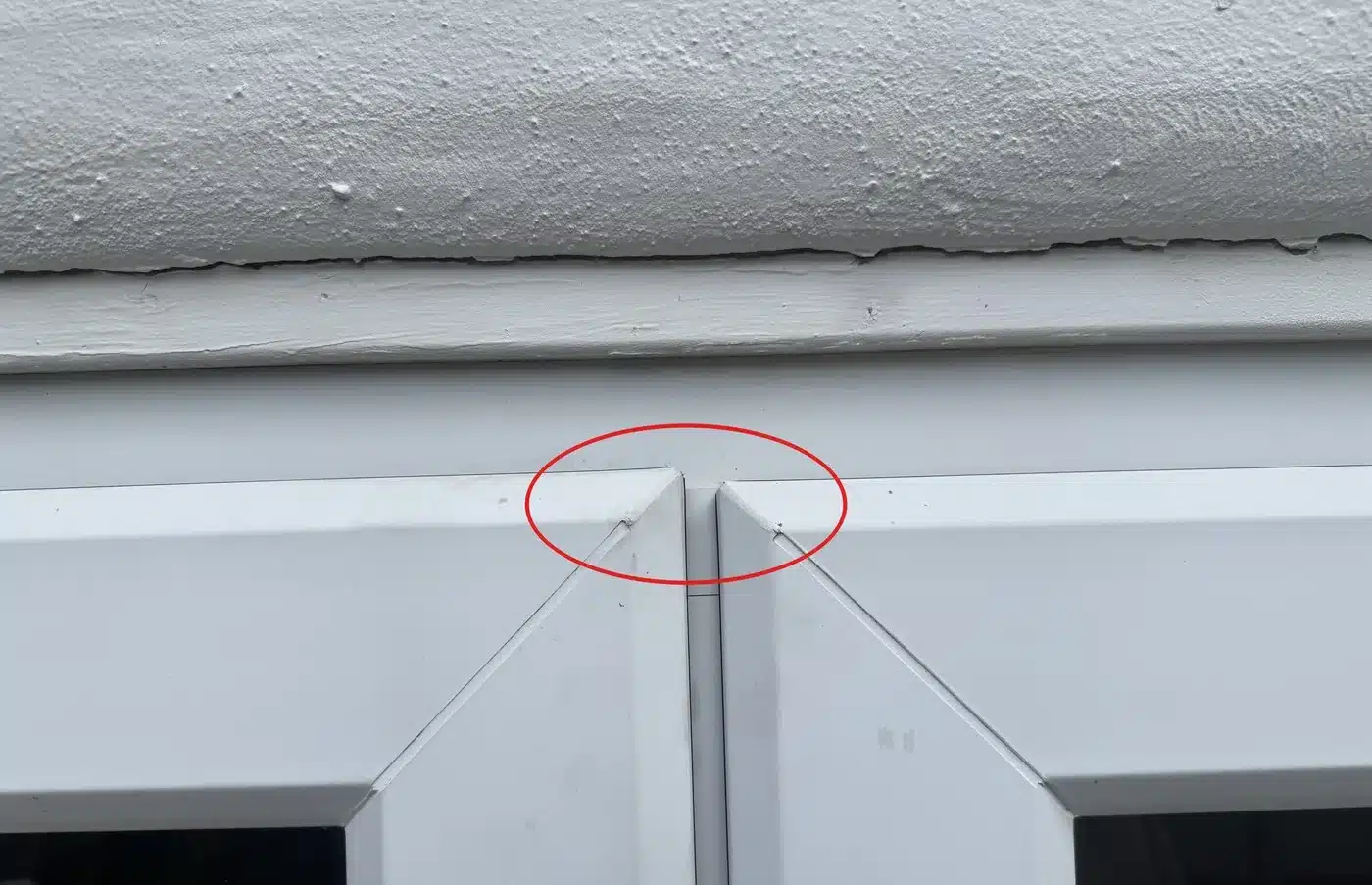
Look at where the two doors meet at the top. They are not sitting level with each other any more. The right hand door was catching the bottom of the frame and the left hand door was catching the top, because that opening is no longer the shape it was when the doors went in. The hooks had jammed in the keeps and the doors would not come open at all.
And here is the part I could not have made up if I tried. Before he rang me, the customer had sprayed the door with WD-40.
I do not blame him for a second. It is what nearly everybody does, and it is what the internet tells you to do. But those doors were not stuck because they were dry. They were stuck because the wall above them had cracked and the opening had gone out of square, and there is no can on this earth that argues with that.
I got them open with no drilling and no damage. Every part came out and went back in, nothing needed replacing, and the doors work again.
That is this whole post in one job. The crack in the wall was the fault. The lock was just where he noticed it.
So why has yours gone stiff?
Because a stiff lock is a symptom, not the fault. In my experience it comes down to three things, and only one of them has anything to do with lubricant.
Dirt and rust. Grit, dust, sand off the street, rust on the shootbolts and in the keeps. This is the one where cleaning and a light lubricant genuinely is the answer, and I will show you how to do it properly further down.
The door has moved. This is the big one, especially on uPVC and composite doors. Doors drop on their hinges. Frames settle. Keeps go out of line by two or three millimetres, which is nothing to look at and everything to the hook that has to find its way in. Timber doors swell and shrink with the weather, which is why so many people find their door is fine in July and awful in December.
Something inside is wearing out. Gearboxes fail. Springs tire. Cams round off. Sometimes the stiffness is the mechanism telling you it has months left.
Put a lubricant in the second or third of those and you have not fixed anything. You have made it turn slightly easier for a fortnight while the real fault carries on getting worse.
If your lock needs oiling to work, the oil is the music turned up
You know that noise the car starts making, and you turn the radio up? It works. The noise goes away. It is a genuinely effective solution right up until the point that it is not.
Oil in a stiff lock is the music turned up.
And this is where it costs people real money, so I want to spell it out.
A door that has dropped a few millimetres is usually a small adjustment. Half an hour, sometimes less, sometimes just a hinge. Sometimes it is a toe and heel, which sounds like a dance move and is a proper job. The glass or the panel inside a door is what holds that door square, so it comes out and the packers behind it get changed until the door sits true again. Done properly it brings a dropped door back into line without anybody going anywhere near the lock. But every time you force it shut, or heave the handle up against the resistance, or lean on the door with your shoulder to get the key round, you are putting all of that load through the gearbox sitting in the middle of the mechanism. Gearboxes tolerate it for a while. Then a follower or a spring inside gives up, and it is always on a cold morning when you are already late.
At that point it is not an adjustment any more. It is a whole new mechanism, often a cylinder with it, and a door that has to be opened before any of that can start. Same door, same original fault, many times the job.
That is not me trying to frighten you into booking something. It is just the order these things happen in, and I watch them happen in that order most weeks.
Is graphite lock lubricant the answer?
Graphite works. I want to be fair about that, because there is a lot of nonsense written in both directions.
But it is not necessary, and a good deal of what you read about it is marketing. Some companies would very much like graphite to be the one true answer, ideally their tube of it, and that advice has been copied between websites so many times it now reads like a law of nature. It is not. It is a product recommendation that got out of hand.
Here is where graphite actually causes trouble, and it is not the graphite’s fault.
You use it. It works. Then the tube runs out, or you cannot find it, or you have moved house. Six months later the lock is stiff again and there is a can of something under the sink. In goes a spray, on top of the graphite, and now you have a black paste that grabs every speck of dust and behaves like nothing either product was designed to do.
That is not a graphite problem. That is a mixing problem. And it is the single most common way people make a lock worse while trying to help it.
The one rule that actually matters: never mix lubricants
If you take one thing away from this post, take this one.
Never mix lubricants in a lock. Not graphite on top of a spray. Not a spray on top of graphite. Not a new can on top of an old one you cannot remember the name of. Pick one and stay with it.
And if you honestly do not know what is in there already, the answer is to clean it out properly, not to add a fifth thing to the pile.
Locks very rarely fail because somebody used the wrong product. They fail because somebody used four.
Can you use WD-40 on a door lock?
It will not kill your lock. It also will not fix it.
WD-40 is a water displacer, which is a genuinely useful thing to be, and it will quieten a squeak for a fortnight. What it will not do is deal with whatever made your lock stiff in the first place, because that was never a lubrication problem.
So no, do not panic if you have used some. It is not the cooking oil. You have not ruined anything. You just have not fixed anything either, and if you now spray something different on top of it, read the section above again. The Belmont doors further up this page are the perfect example: a full can of it would not have moved that wall by a millimetre.
Where it makes no sense at all is at the other end of the story. When the door is stuck shut, the mechanism has jammed, or the key has snapped off because it was too hard to turn, people stand there spraying the door, the handle, the stub of the key. I understand the instinct completely. But it is not a magic liquid. It cannot reach a broken metal part inside a mechanism you cannot see, and it certainly cannot heal one. By then the fault is physical, the spray is nowhere near it, and what you need is somebody who can get the door open and the mechanism out and tell you what actually broke.
How to look after your locks properly
Once or twice a year is plenty. It takes about twenty minutes, it costs almost nothing, and it is the whole reason I am able to write a post telling you not to buy lubricant.
Do it at the turn of the seasons if you want something to hang it on. Spring and autumn, when the heating is going on or off, because that is exactly when doors move most.
1. Clean it first. Wipe down the edge of the door, the shootbolts and hooks, and the keeps in the frame. Your window locks stiffen the same way and want the same treatment. Get the dust, grit, rust and old gunk off. This is the step everybody skips and it does most of the work. Lubricating over grit does not clean anything, it just makes a grinding paste and spreads it about.
2. Then lubricate, lightly. Silicone lubricant or PTFE lubricant. Shootbolts, rollers, the keeps, and the hinges. Light. You are not filling anything up.
3. A short puff into the keyway, then put the key in, work it in and out a few times and turn it. A short puff. Not a bottle.
4. Close the door slowly and watch it. This is the actual diagnostic and it is free. Does the door catch on the frame anywhere on its way in? Does the handle need a shove to lift? Is there a shiny worn mark on a keep where the hook is hitting it instead of going into it? Is the gap down the closing edge the same at the top as it is at the bottom? A door that has dropped will tell you, if you give it ten seconds of attention.
5. Tighten anything loose. Hinge screws, handle screws, keep screws. Loose screws are how a door starts dropping in the first place.
That is the whole job. Twice a year.
What to use, and what to keep well away
Use silicone lubricant or PTFE lubricant. That is it. It does the job perfectly on all of it, keyway and mechanism and hinges alike, and if you only ever buy one thing for your locks, buy one of those and buy it once.
What to keep away from, and I am not being clever about any of these because I have seen all of them:
- Cooking oil, olive or otherwise
- General purpose oils like 3-in-1, which go tacky and then collect dust
- Vaseline or any thick grease, which does the same and gets worse in the cold
- Whatever was already open in the shed
The pattern is the same every time. Anything that stays wet or sticky becomes a dust trap, and a dust trap in a lock becomes grinding paste. The good stuff goes on thin and stays slippery without holding on to dirt. That is the entire difference.
When it is too late for any of this
Some of these are past the point where a maintenance job helps. If any of this is happening, the fault is mechanical and it needs opening up, not spraying. They are among the common lock problems I get called out to most.
- You have got your key, and the door will not open
- The key has snapped off in the lock
- The handle lifts but the key will not turn, or turns and nothing happens
- You have to lift and shove and hold the door to get it locked
- It only locks if you pull the door towards you first
That first one deserves a word, because people apologise to me for it. If you have your key and the door will not open, that is a lockout. I know it does not feel like one, standing there with the key in your hand. It is one of the most common calls I get.
It very often does not need drilling either. Sometimes I can work out why it will not turn and free it off. On a lot of faulty cylinders it is one screw out, old one slides out, new one slides in. Anyone who arrives at that door and reaches for the drill first is not out of options. They have just skipped them.
What I would actually do in your position
Twenty minutes, twice a year, with a can of silicone lubricant or PTFE lubricant and a rag. If you would rather somebody went round the whole house, that is what a security check is for, and my rates are published if you want to know what the work costs. Clean before you lubricate. Never mix what is in there. And when the door starts feeling different, take that seriously the first time, not the fifth.
Because the thing that separates a hinge adjustment from a new mechanism is not the fault. It is how many months you spent forcing it before somebody looked. A lock seller is quite happy to meet you at the end of that road and sell you the mechanism. I would rather catch you at the start of it, tell you it is a hinge, and be gone in half an hour.
Common questions about lock lubricant and stiff locks
What is the best lubricant for locks?
Silicone lubricant or PTFE lubricant. Both go on thin, stay slippery and do not attract dust, and either one will do every part of a door, from the keyway to the shootbolts to the hinges. More important than which one you choose is that you clean the parts first, use it sparingly, and never mix it with anything already in there.
Should I use graphite lock lubricant?
You can. Graphite works, but it is not necessary, and a lot of the advice telling you it is essential is product marketing that has been copied between websites for years. The real risk comes later, when the graphite runs out and somebody sprays a different lubricant on top of it. That combination turns into a paste that holds dust and makes the lock worse than it was.
Can I use WD-40 on a door lock?
It will not damage your lock, but it will not fix it either. WD-40 is a water displacer rather than a lubricant, so it eases things briefly and then wears off without touching the underlying cause. If a lock is stiff, the cause is usually dirt, a door that has moved, or a mechanism that is wearing out, and none of those are solved by a spray.
Why is my uPVC door lock stiff?
Seven times out of ten it is the door, not the lock. uPVC doors drop on their hinges over time and the keeps in the frame go out of alignment, so the hooks and rollers have to force their way in. The other three times out of ten it is a mechanism that has never been cleaned in its life. Lubricant makes either of them turn a bit easier for a fortnight, but it fixes neither, and forcing the handle is what eventually breaks the gearbox.
Why is my door lock stiff in winter?
Because doors and frames move with temperature and damp. Timber swells, uPVC contracts in the cold, and a door that was only just clearing its keeps in the summer starts catching them in December. A door that is already borderline in the warm months is the one that fails on the first proper cold morning.
How often should I lubricate my locks?
Once or twice a year is enough for almost every house, and cleaning matters more than lubricating. Spring and autumn are a sensible habit because that is when doors move most. Anything more frequent than that is usually a sign that something mechanical is wrong and the lubricant is masking it.
Why is my key not turning in the lock?
It can be a worn key or a worn cylinder, a door under pressure so the bolt is binding against the keep, or a fault inside the cylinder or gearbox. If the key turns freely when the door is open but not when it is closed, the problem is alignment, not the lock. If it will not turn either way, something inside has failed and it needs opening up rather than spraying.
Can I fix a stiff door lock myself?
Often, yes, if it is dirt or a loose screw. Clean the door edge, shootbolts and keeps, apply a little silicone lubricant or PTFE lubricant, and tighten any loose hinge, handle or keep screws. What you should not do is force a door that is resisting, or keep adding lubricant when it makes no difference, because that is how an adjustment turns into a replacement mechanism.
Door getting harder to lock?
If your door has started needing a shove, or the key is getting stiffer month by month, get it looked at while it is still an adjustment. It is a far smaller job in September than it will be in January.
Call Andrew: 073 7617 6366 Or contact me at: andrewthelocksmith.com/contact-andrew-the-locksmith