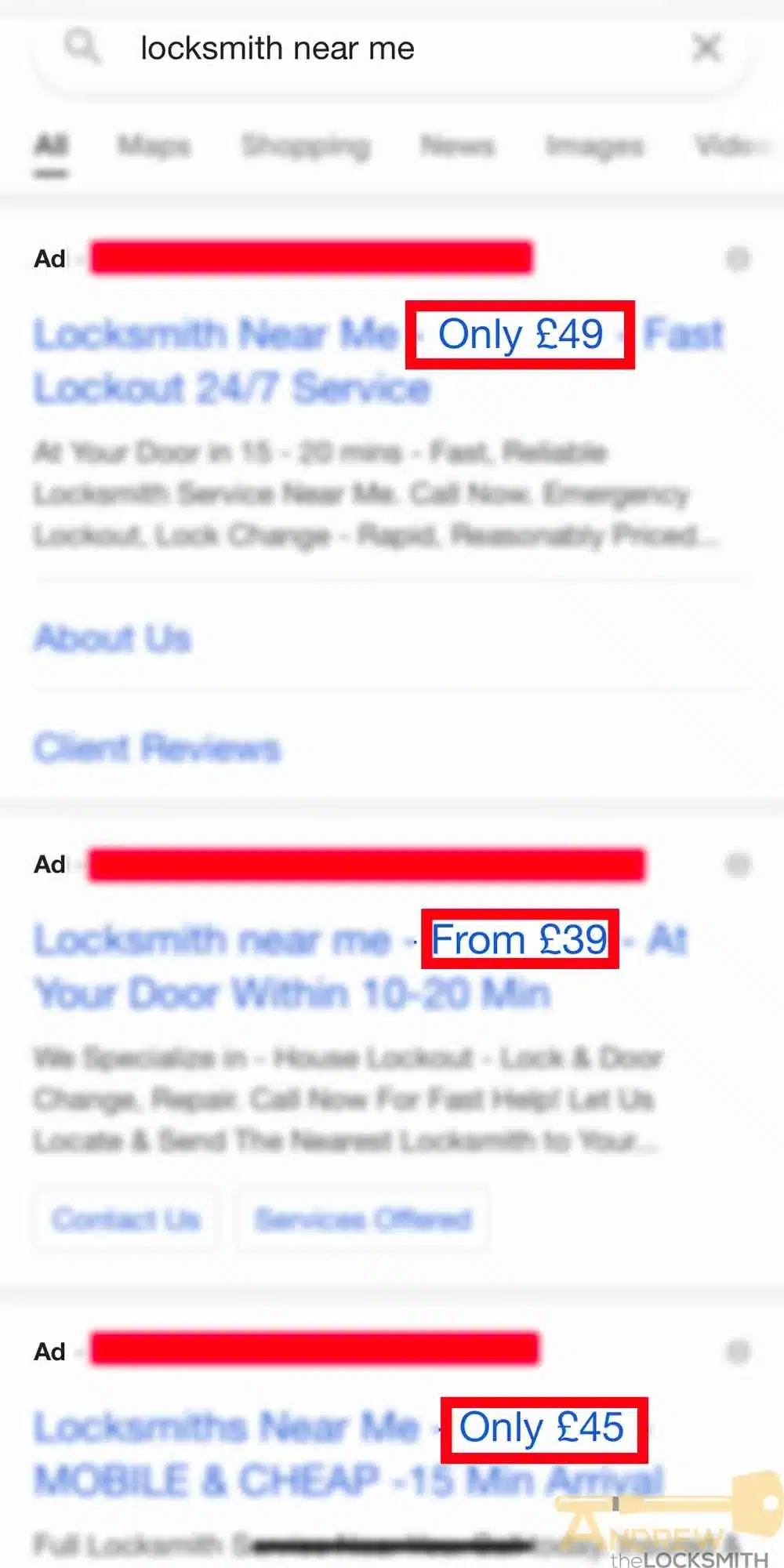
Why Do Locksmiths Advertise £49 Then Charge £300?
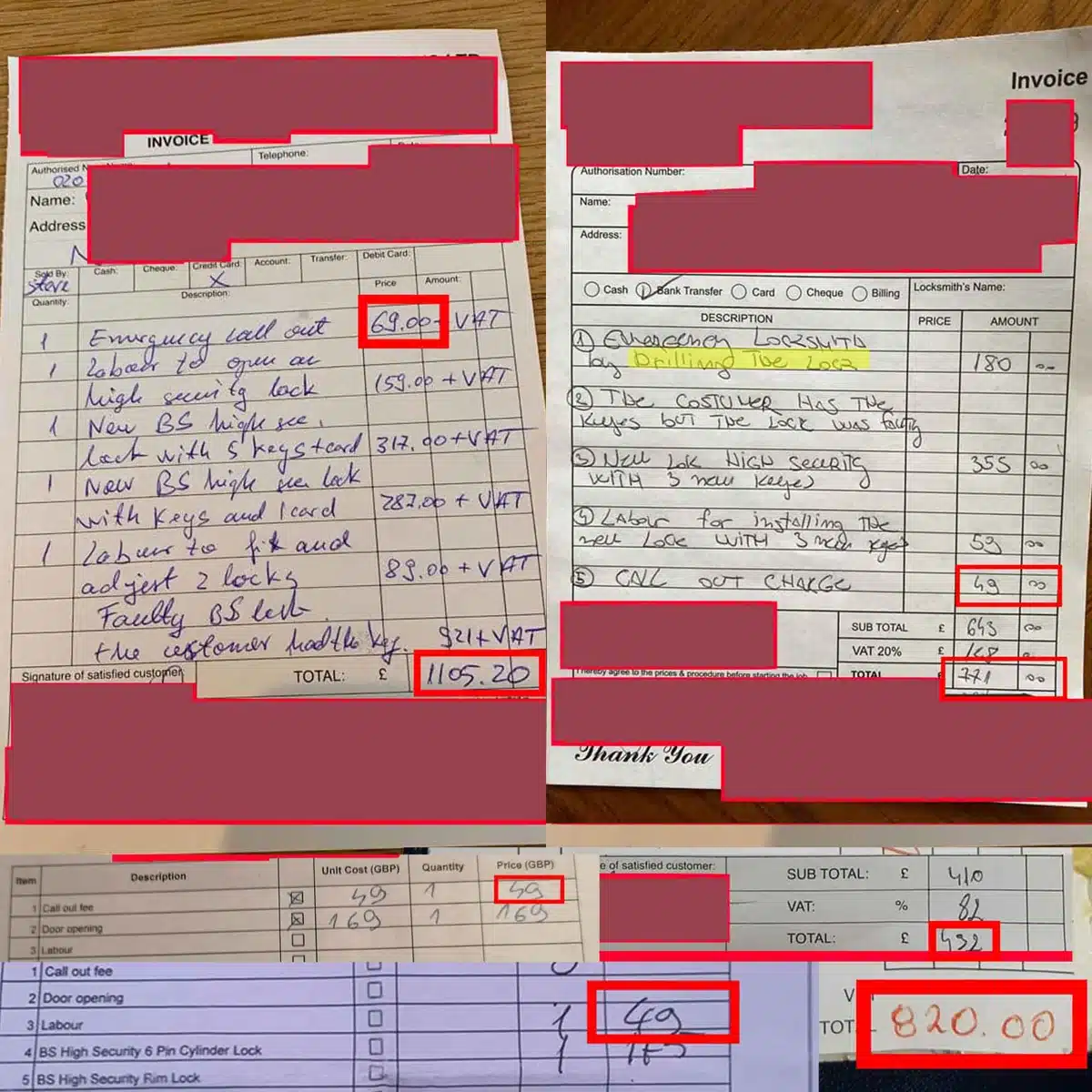
Short answer: Because £49 isn’t the price of the job. It’s the price of somebody arriving. On nearly every one of these adverts that number is the call-out fee, and it buys you exactly one thing: a van outside your house. The labour is charged separately on top, sometimes twice on the same visit, then the parts, then VAT. And £300 is the optimistic version. I’ve got a real invoice in front of me where £49 became £771, and a worse one that came to £1,105.20. The fix is simple: ask for the total rather than the rate, and get it written on the job sheet and signed before the work starts, not after.
A real £771 invoice, from a job in Kenton
This isn’t a story I’ve been told secondhand. I’ve got the paperwork.
The customer had his key. Nothing lost, nothing snapped. The door simply wouldn’t open with it. That’s one of the most common calls I get, and it’s a normal lockout, just a quieter one than the sort where the key’s still on the kitchen table. He searched online, rang a “from £49” advert, and someone came out.
Here’s what he was charged, straight off the invoice:
| Line on the invoice | Amount |
|---|---|
| Call out charge | £49.00 |
| “Emergency locksmith by drilling the lock” | £180.00 |
| New high security lock with 3 new keys | £355.00 |
| Labour for installing the new lock | £59.00 |
| Subtotal | £643.00 |
| VAT at 20% | £128.60 |
| Total | £771.00 |
Read that second line again, because it’s the whole scam in six words. He was charged £180 for the lock to be drilled. Then £355 to replace the thing that had just been drilled. He paid a premium for the destruction, and then paid again for the consequence of it.
And the £49? It bought him a van arriving. That’s it. Labour appeared twice more after that, once to destroy the lock and once to fit its replacement.
The part I can’t get past is the order it all happened in. A door that won’t open with the right key is bread and butter for a locksmith, and there’s a long list of things to try before anything gets destroyed. Work out why it isn’t turning. Pick it. On plenty of faulty cylinders you can get the old one out with a single screw and slide a new one straight in, no drilling anywhere near it. Drilling is what’s left when all of that has failed. It isn’t where you start.
Whether every one of those options was tried on that door, I honestly can’t tell you from a piece of paper, and I won’t pretend otherwise. What I can tell you is that £49 to arrive, plus £180 to drill, plus £59 to fit, is three separate labour charges for one visit to one door. And no job like that is worth £771.
That one isn’t even the worst I’ve got on file. There’s another with the line “faulty BS lock, the customer had the key” written on it. Exactly the same situation: key in hand, door won’t open. A £69 call-out, £159 to open, two new locks at £317 and £287, and £89 to fit them came to £1,105.20 with VAT.
Where the rest of the bill comes from
Nothing on that invoice was hidden. It just wasn’t mentioned while he could still say no. There are four places it happens, and they’re the same four every time.
1. The advertised number is the call-out fee. This is the bit almost nobody realises. “From £49” isn’t a price for opening your door or changing your lock. It’s the fee for turning up. Everything that happens after the van door closes is billed separately.
2. Labour, charged more than once. Look at the invoice again: £180 of labour to drill the lock, then another £59 of labour to fit the new one. Two labour lines, one visit, one door. Add “emergency attendance”, minimum charges, and a second hour that started at sixty-one minutes, and individually they all look small. Stacked on top of each other they double a bill.
3. Parts. This is where the real money lives. Labour gets advertised because it can be made to look cheap. Parts never get advertised, because they vary from job to job, which conveniently means they don’t have to be. A euro cylinder that costs £30 to £35 can appear on an invoice at £355, described as “high security” whether it is or isn’t. When a new cylinder genuinely is needed, you should be shown the options and the prices before it goes anywhere near your door.
4. VAT. That £643 became £771 with VAT on it. Plenty of adverts quote the pre-VAT number because it reads better. Always ask whether the figure includes it.
To drill or not to drill
Whether your lock survives the visit is the single biggest factor in what you pay. Get that right and you’re paying for an hour of someone’s time. Get it wrong and you’re buying a lock as well, at whatever price they fancy putting on it.
Drilling is easy. It needs no real skill, it takes a couple of minutes, and it guarantees a parts sale, because a drilled lock can’t be reused. Picking is harder, takes longer, needs proper tools and years of practice, and earns nothing extra. You can see the incentive without me having to spell it out.
But I’ll be fully honest with you here, because I’d rather you trusted me than thought I was preaching. There’s nothing worse than drilling a lock, and I do it too in some situations. The difference is when. I drill only after I’ve tried every non-destructive method I’ve got, and only when there’s genuinely nothing else left. Drilling isn’t the answer to every problem either. You need to know exactly where to drill and how to drill, and doing it properly is a skill in itself. Reaching for the drill first, before anything else has been attempted, is the bit that should worry you. That’s not a technique, that’s a sales decision.
So it’s a fair question to ask out loud, and a polite one: “Will you try to open it without drilling?” A locksmith who can, will. It’s the part of the job we’re actually proud of.
The five questions that stop this happening
You don’t need to know anything about locks to protect yourself. You need thirty seconds on the phone and these five questions.
- “Is that £49 the total, or is it just the call-out fee?” The single most useful sentence in this whole article.
- “What’s your labour on top of that, and does it change at this time of night?”
- “If a new lock is needed, what will the part cost me?” Get a figure, or at least a range.
- “Does your price include VAT?”
- “Will you try to open it without drilling?”
Then one last step, and this is the one that actually protects you: get the job sheet signed before the work starts, not after.
Have a look at the bottom of a locksmith’s paperwork and you’ll usually find a printed line along the lines of “I hereby agree to the prices and procedure before starting the job”, with a box next to it. That line exists for a reason. It’s the moment where the price stops being a conversation and becomes an agreement, and it’s meant to happen while you can still say no, before a single tool comes out of the van.
So don’t sign anything at the end. Ask for the full price, written on the job sheet, and sign it before the work begins. A genuine locksmith will hand it straight over, because the number isn’t going to change. Anyone reluctant to put the total in writing up front has told you everything you need to know, and you’ve lost nothing but a minute.
What it should actually cost
Here’s that same Kenton job, side by side. Customer has his key, door won’t open with it, standard door, standard hours.
| The “from £49” version | How I do it | |
|---|---|---|
| Call-out fee | £49, and that’s just to arrive | None |
| Getting the lock open | £180 to drill it | Picked or the cylinder swapped out wherever I can |
| New lock | £355 for a cylinder costing £30 to £35 | Only if it’s genuinely needed, options and prices shown first |
| Fitting labour | £59, charged separately again | Included in the labour I quoted you |
| Out of hours | Uplift applied, often unmentioned | £99 evenings, £120 nights, told to you on the phone |
| VAT | £128.60 on top | I’m not VAT registered, so there’s no VAT to add |
| Final bill | £771.00 | £89 labour, plus the part if one is genuinely needed |
That’s not me being generous, it’s just what the work costs when nobody’s trying to sell you a lock. All of it is published on my prices page, and I’ve broken down what a locksmith should actually cost in 2026 job by job if you want to sense-check a quote you’ve been given by somebody else.
Andrew’s advice
There’s a difference between a locksmith and a lock seller, and the advert tells you which one you’re looking at before you’ve even dialled.
A locksmith sells you skill and time, so he can tell you the price on the phone, because he already knows what the job takes. A lock seller sells you parts, so the price can’t be known until he’s seen what he can persuade you to buy. That’s the whole reason the number moves. It was always going to.
So here’s the honest version of my own advert: my labour starts at £89 in standard hours, I don’t charge a call-out fee, there’s no VAT on top, and I’ll tell you the total before I get in the van. If I can open your lock without destroying it, I will, and you’ll keep the lock you already paid for once. If it genuinely needs replacing, I’ll show you the options and what each one costs before I touch it.
And if you’d rather never be in this position at all, the answer isn’t cleverness on the doorstep. It’s a saved number. I’ve written up how to check a locksmith is genuine in about two minutes, and it’s worth doing on a quiet afternoon rather than at eleven at night in the rain.
£49 then £300: FAQs
Why do locksmiths advertise £49 then charge £300?
Because the £49 is almost always the call-out fee, not a price for the job. It buys you a van arriving and nothing else. Labour is charged separately on top, sometimes more than once on the same visit, then parts, then VAT. On a real invoice I’ve seen, £49 became £771 that way. Ask for the total price rather than the advertised rate, and get it written on the job sheet and signed before the work starts.
Is it legal to advertise “from £49” and then charge £300?
Usually yes, technically, and that’s exactly why it works. The word “from” is doing a lot of heavy lifting. As long as the final bill is agreed before the work starts, there’s often no rule broken. But you’re entitled to a full price before anyone begins, so if a figure appears only after the job is done, that’s a genuine complaint and worth raising with Trading Standards.
Why is the advertised locksmith price always the call-out fee?
Because it’s the smallest number they can put in an advert. Labour varies with the job and parts vary even more, so neither can be advertised honestly, which conveniently means neither has to be. On a bill that’s mostly parts and repeated labour, the advertised figure barely matters.
How much should a lock change actually cost in the UK?
Labour plus the real cost of the part. For me that’s £89 in standard hours, plus a cylinder at a fair price depending on what you choose. A standard euro cylinder costs £30 to £35. If a quote comes in at ten times that for the part alone, ask for it to be itemised separately from the labour. That one request tends to clear things up quickly.
Can I refuse to pay if the locksmith price went up after they arrived?
You can dispute it, and you’re on stronger ground if you never agreed the higher figure in writing. But disputing a bill after the fact is a miserable way to spend a week. The far better move is to head it off: get the full price written on the job sheet and sign it before the work starts, not after. Then there’s nothing to argue about.
Do you charge a call-out fee?
No. No call-out fee, no charge for quoting, and no VAT, because I’m not VAT registered. You pay for the finished job at the price I agreed with you before I started.
Get the price before anyone sets off
If you’re weighing up a quote right now, or you’d just rather have a straight number from someone local, give me a ring and I’ll tell you what the job costs before I leave. No call-out fee, no VAT, and the price I say on the phone is the price you pay, across Harrow and the surrounding areas.
Call Andrew: 073 7617 6366 Or get in touch at: andrewthelocksmith.com/contact-andrew-the-locksmith
Andrew the Locksmith is a Master Locksmiths Association member serving Harrow, Kenton, South Harrow, North Harrow, Pinner, Wembley, Watford, Ruislip, Northolt, Stanmore, Wealdstone and surrounding areas. No call-out fee. Clear prices on the phone.