What Is a BS3621 Lock? (And Why Your Insurer Keeps Asking For One)
 A BS3621 lock is a lock that has been tested and certified to the British Standard for thief resistance, and carries the BSI kitemark stamped on it to prove it. On a timber front door that usually means a five lever mortice deadlock or sashlock. The important part is the stamp, not the lever count, because plenty of five lever locks have never been near a test house.
The tick box that costs people their claim
I was in Rayners Lane earlier this year to sort out a back door that had dropped and stopped locking properly. Ten minute job. While I was packing up, the lady of the house mentioned her home insurance was up for renewal, and asked, half in passing, whether her locks were alright.
So I had a look at the front door. Lovely old timber door, solid frame, and a five lever mortice deadlock that somebody had clearly paid decent money for. She told me the previous owner had it fitted, and that when she filled in her renewal she had ticked the box for British Standard locks, because five lever is British Standard, isn’t it.
I opened the door and looked at the faceplate on the edge. Five levers, yes. No kitemark. No BS3621. Nothing stamped on it at all beyond the maker’s name.
She had not lied on her insurance form. She had answered honestly, based on what she believed was true, and what almost everybody believes is true. But if she had been broken into through that door, her insurer would have looked at that faceplate before they looked at anything else, and the conversation after that would not have been a nice one.
I changed it for her that week, and while I was there I ran through the rest of the doors and windows, which is what a proper security check is for.
That is the whole reason this post exists. The gap between “five lever” and “BS3621” is invisible from the inside of your house, and it is the single most common misunderstanding I come across.
What BS3621 actually is
BS3621 is a British Standard, published by BSI, that sets out how much punishment a lock has to take before it is allowed to carry the mark. It is not a brand, it is not a lock type, and it is not something a manufacturer can award itself.
The current version is BS 3621:2017+A1:2024. Worth saying, because a lot of locksmith websites still quote BS 3621:2007+A2:2012, which was withdrawn back in June 2017. If you are reading advice that cites the old number, it has not been updated in a while.
In practical terms, a lock has to stand up to a serious attempt to defeat it before it earns the mark:
- Picking and manipulation. The mechanism has to resist someone working it open with tools.
- Drilling. Hardened plates inside the lock body sit in front of the parts a drill would go for.
- Force. The bolt has to throw far enough into the frame to stop the door being levered or kicked through, normally at least 20mm.
- Key differs. Enough different key combinations that your neighbour’s key will not open your door by accident.
The key word in the full title of the standard is both. BS3621 covers locks operated by key from both the inside and the outside. You need a key to get out as well as in. That matters, and I will come back to it.
Decoding the sentence in your insurance policy
Nine times out of ten, the reason somebody rings me about this is that they have opened their policy and found a sentence like:
“All final exit doors must be fitted with a five lever mortice deadlock conforming to BS3621.”
People read that and hear one requirement. It is actually three, and they all have to be true at once.
“Five lever” describes the mechanism inside the lock. Five levers rather than two or three.
“Mortice deadlock” describes the type and where it sits. Mortice means it lives in a pocket cut into the edge of the door, not screwed onto the surface. Deadlock means it throws a bolt and nothing else, no latch, no handles.
“Conforming to BS3621” is the bit that does the actual work. It means that specific lock has been tested and certified. Without it, the first two phrases are just a description of a lock, and a description is not a certificate.
“Final exit door” is worth a mention too, because it is the phrase people get wrong most often. A final exit door is an outside door that you lock behind you when you leave the house empty. Two things have to be true at the same time: the door leads outside, and it is the one you turn a key in on your way out.
Your bedroom door fails the first test, no matter how diligently you lock it. A patio door you bolt shut from the inside fails the second. Front door, back door, side door: those are the ones your policy means.
The mistake I see most often with final exit doors
Build a porch, and the door you have called the front door for twenty years stops being an outside door. It is now an internal door standing in a little corridor. The porch door is the one that leads outside, and it is the one you lock on your way out, so that is the door your policy is talking about.
I come across this a lot. Lovely solid timber door with a proper BS3621 mortice on it, sitting behind a thin porch door with whatever basic lock the builder had in the van. From the inside it feels like an upgrade. On paper the house has gone backwards, and nobody has told the insurer anything.
Now forget the insurance for a moment, because there is a worse problem. A weak porch door does not only fail the policy. It hands a burglar somewhere to stand. Once he is through that flimsy outer door he is inside a small room, out of sight of the street, out of the weather, and out of the neighbours’ view, with as long as he likes to work on your good front door. A cheap lock on a porch turns your best door into a private job.
So if you have had a porch put on, the outer door is the one to get right, whatever your policy happens to say. Same story at the back when a conservatory or a side return goes on. The old back door becomes internal, and the conservatory door quietly becomes the one that matters.
If you lock both doors on your way out you are in better shape than most people, but it is still worth ringing your insurer and asking which one they want the standard on. Five minutes on the phone, and it is the sort of thing you want settled before a claim rather than during one.
Five levers is not the same as British Standard
I want to be blunt about this one, because it is where people get caught.
Two lever, three lever and five lever mortice locks all exist, and all of them are perfectly legitimate products. They belong on internal doors, cupboards, sheds, garage side doors, anywhere the risk is low. A five lever lock with no stamp is not a fake and it is not a con. It is simply a lock that was never submitted for certification, and it is doing exactly the job it was sold to do.
The problem is what happens when it ends up on a front door and somebody assumes the lever count is the qualification. It is not. BS3621 is the qualification. The lever count is a detail inside it.
If you take one thing away from this page, make it that sentence.
How to check your own lock in about a minute
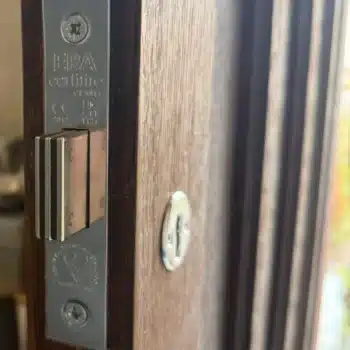
You do not need me for this bit. Open your front door and look at the edge of the door, at the long metal faceplate where the bolt comes out.
What you are looking for is two marks:
- The BSI kitemark, which is a small symbol shaped a bit like a heart drawn with one continuous line.
- The number BS3621 itself, usually with the year alongside it.
Both should be stamped or engraved into the metal of the faceplate or the forend. On some locks the marks are on the lock case rather than the faceplate, so if the door is off or you can see into the edge, have a look there too.
If the marks are not there, it is not a BS3621 lock. Not “probably”, not “it might be an older one”. The mark is the entire point of the standard. No stamp, no certification.
Two things that catch people out. Old locks can be genuinely certified but so painted over you cannot read anything, so scrape gently before you conclude anything. And a proper BS3621 lock fitted badly, or into a frame with no reinforcement behind the keep, does not perform like a BS3621 lock. The certificate covers the lock, not the fitting.
It is not only mortice locks
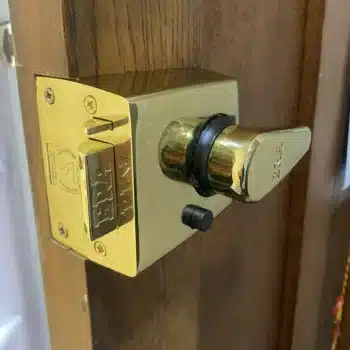 Most people meet BS3621 as a mortice deadlock, but the standard covers more than that. There are night latches certified to BS3621 as well, the auto deadlocking sort, and they are a very different animal from the ordinary Yale type latch that most houses have on the front door.
A standard night latch is a convenience. It holds the door shut, it is not a deadlock, and on its own it will usually not satisfy an insurer. A BS3621 night latch deadlocks itself when the door closes and has to be unlocked with a key from either side. If your front door has a latch at the top and a mortice below, the mortice is normally the one doing the insurance work, but it is worth checking both. I go through the combinations in more detail in my guide to the best lock for a front door.
What if I have a uPVC or composite door?
Then BS3621 mostly is not your standard, and this is where a lot of confusion comes from.
uPVC and composite doors use a euro cylinder driving a multipoint mechanism down the edge of the door. That is a different bit of kit entirely, and the standards that matter there are TS007 3 star and Sold Secure Diamond, which are about resisting lock snapping rather than picking and drilling. If your policy says BS3621 and you have a uPVC door, ring your insurer and ask what they want instead, because the wording on a lot of policies has simply not caught up with the fact that half the country’s front doors are not timber any more.
If you are not sure which sort of door you have, my guide to the types of door locks walks through how to tell in a minute or two.
One safety point, and it is important
Because BS3621 needs a key to get out as well as in, think carefully before you put one on the only exit from a flat, a bedsit or anywhere somebody might need to leave in a hurry with no time to hunt for a key. There is a separate British Standard for locks you can open from the inside without a key, and in some buildings that is the one you should be fitting.
If you live in a flat or you let a property out, mention it when you ring me and I will tell you which way round it should be. It is not a detail worth guessing at.
What actually happens if you have not got one
Nothing, right up until it matters.
An insurer will not check your locks when you take the policy out. They check afterwards, when you claim, and by then the lock either has the mark or it does not. Most claims are not refused outright over it, but it hands the insurer a reason to argue, and arguing with an insurer from inside a burgled house is a rotten position to be in.
The honest advice is the same either way. Read your own policy wording rather than take anybody’s word for it, mine included. If you want, take a photo of the paragraph and a photo of your door edge and send them both to me. I will tell you whether the one meets the other, and it costs you nothing to ask.
And if it does need changing, changing a mortice lock is a straightforward job on a door that is already prepared for one. It is not a new door, it is not a new frame, and it is a lot less than most people brace themselves for. My rates are all on my locksmith prices page if you want to hold a quote up against them.
Common questions about BS3621 locks
What is a BS3621 lock?
A BS3621 lock is a lock certified to the British Standard for thief resistance, tested for resistance to picking, drilling and force, and stamped with the BSI kitemark and the number BS3621 to prove it. On a timber front door it is usually a five lever mortice deadlock or sashlock. Most UK insurers ask for one on final exit doors.
How do I know if my lock is British Standard?
Open the door and look at the metal faceplate on the edge of the door. A genuine BS3621 lock has the BSI kitemark and the number BS3621 stamped into the metal. If neither mark is there, it is not a British Standard lock, whatever else is stamped on it. Old paint can hide the marks, so clean the faceplate before deciding.
Is a five lever mortice lock the same as a BS3621 lock?
No. Five levers describes the mechanism inside the lock. BS3621 means that lock has been tested and certified. Plenty of five lever mortice locks carry no certification at all and are sold for internal and low risk doors. If your insurer asks for BS3621, the stamp is what they mean, not the lever count.
What does “five lever mortice deadlock conforming to BS3621” mean?
It is three requirements in one sentence. Five lever describes the mechanism, mortice deadlock describes a bolt only lock fitted inside the edge of the door, and conforming to BS3621 means it is certified to the British Standard and stamped accordingly. All three have to be true, and the certification is the part that carries the weight.
Does a porch or extension change which lock my insurance needs?
Yes, and it catches a lot of people out. A final exit door is an outside door that you lock behind you when you leave the house empty. Once a porch is built in front of your old front door, that door is no longer an outside door, and the porch door becomes the final exit door. A thin porch door also gives a burglar somewhere out of sight to work on your good front door, so it is worth getting right whatever your policy says.
What is the current version of BS3621?
The current version is BS 3621:2017+A1:2024. It replaced BS 3621:2007+A2:2012, which was withdrawn in June 2017. Many websites still quote the older number, so it is a fair sign of how recently a page has been updated.
Do I need a BS3621 lock on a uPVC door?
Usually not. uPVC and composite doors use a euro cylinder and a multipoint mechanism, where the relevant ratings are TS007 3 star or Sold Secure Diamond rather than BS3621. If your policy still specifies BS3621 and your door is uPVC, ask your insurer what they accept instead.
What happens if I do not have a BS3621 lock?
Nothing until you claim. Insurers check locks after a break-in, not when you take the policy out, and a missing kitemark gives them a reason to question the claim. Read your own policy wording, check the faceplate on your door, and get it changed before you need it rather than after.
Why I would rather you knew this
There is money in people not knowing what BS3621 means. I could turn up, glance at a door, say “that’s not British Standard, you’ll need a new lock” and you would have no way of checking whether I was right. Some do exactly that.
But a lock that already carries the mark does not need replacing because somebody in a van says so, and a door that genuinely needs upgrading needs one lock, not four. Knowing what the stamp looks like puts you in a position to tell those two situations apart. That is a better outcome for you, and it is the only sort of work I want.
Not sure whether your lock has the stamp?
Send me a photo of the edge of your front door, or ring and describe what is on it, and I will tell you straight whether it is BS3621 and whether it meets what your insurer is asking for.
Call Andrew: 073 7617 6366 Or contact me at: andrewthelocksmith.com/contact-andrew-the-locksmith