
The day Harrow Fire Station asked me to train their firefighters
The phone call
My phone rang one afternoon in November. A firefighter from Harrow Fire Station, up on Pinner Road.
He wasn’t locked out.
He wanted to know if I’d come down to the station and talk to his crew about locks. How they work, and how to get through one without wrecking the door. He cc’d his officer in charge into the follow-up email.
I said yes on the phone, then asked him to put it in writing. Partly to be sure I’d understood him properly. Firefighters don’t usually ring locksmiths for advice. It’s normally the other way round.
What they actually wanted (not what you’d think)
Let’s be clear about one thing. The fire brigade can get through any door. That was never in question. They’ve got a hydraulic spreader and they know exactly what to do with it.
Sometimes I wish I had their big tool. (I’m talking about the spreader. Nothing else.) And the red and blue lights on my van.
What they wanted was to get in without destroying the place.
Think about when that matters. Someone’s had a fall behind a locked door. The door isn’t the emergency, it’s just in the way. If you take the frame out, that person comes home from hospital to a house that won’t lock, on the worst week of their life. So the crew were after the least destructive way in, and they wanted to know which tools were actually worth buying.
That’s a genuinely good question. It’s also why they rang a locksmith instead of watching videos.
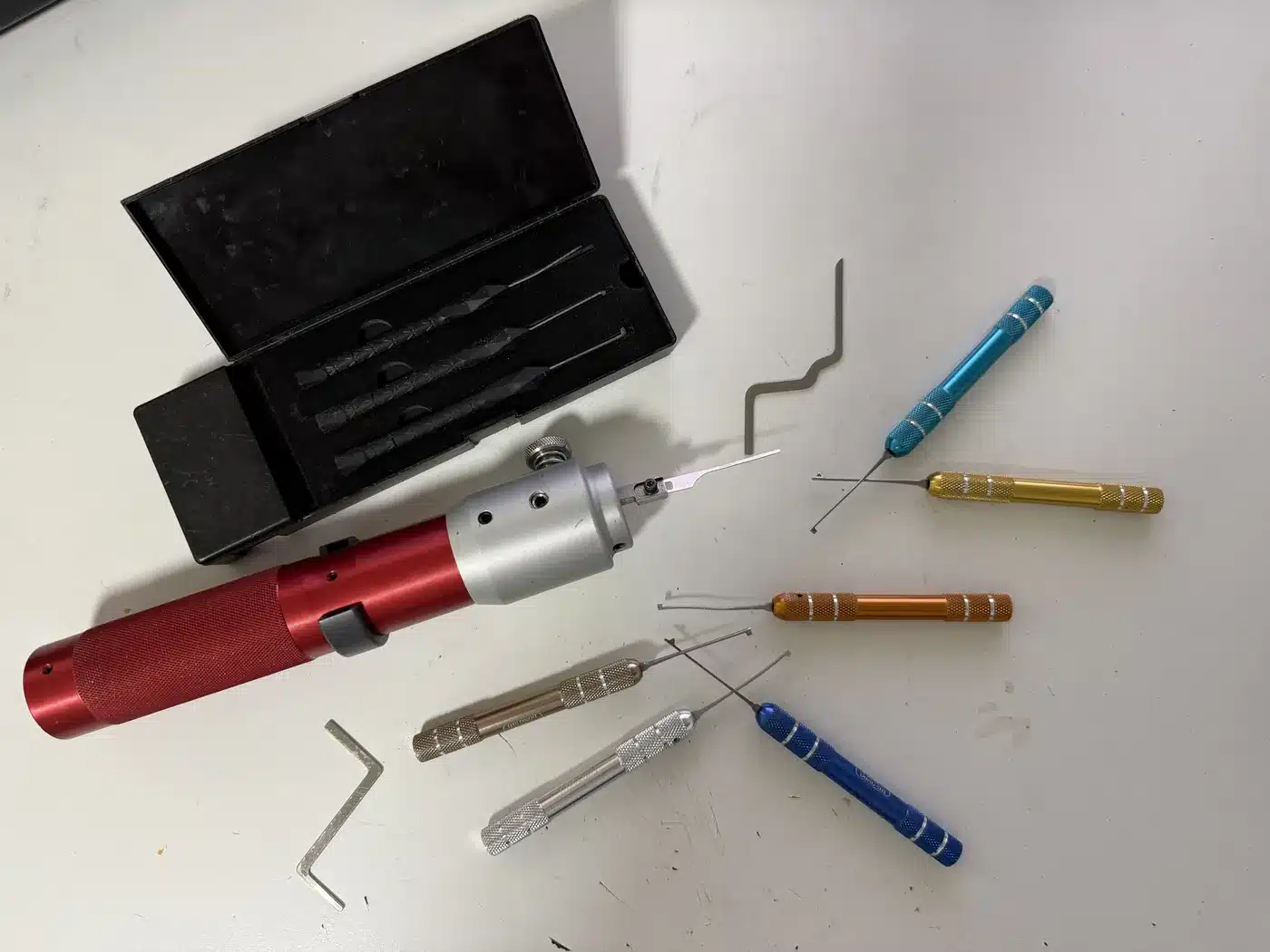
3 December 2025
I spent a session at the station with six of their firefighters.
I’ll be honest about my credentials for this. I’m a Qualified Master Locksmith and a member of the Master Locksmiths Association, and I’ve been doing this for over ten years. I am not a lecturer. I said exactly that at the start, apologised in advance for any mistakes, and then we got on with it.
I’d rather tell you that than pretend I turned up as some kind of expert instructor.
What we covered
How a euro cylinder actually works. The plug, the housing, the springs, the pins, and the shear line.
The cam. The little lug in the middle of the cylinder that everything else exists to protect. Every method of opening a lock, from a picked cylinder to a burglar with vice grips, is just a different way of turning that one piece of metal. Understand the cam and the whole thing makes sense.
Why a lock’s appearance tells you almost nothing. In his first email they’d asked about dimple locks, assuming those were the tough ones. So I put two cylinders on the table. The dimple, the one they expected to be hard, I opened in seconds. The plain, ordinary looking one sitting next to it took me about half an hour, and half an hour is precisely what a firefighter hasn’t got. It doesn’t matter what a cylinder looks like from the outside. It matters what’s inside it.
Multipoint locking systems. Hooks, rollers, deadbolts, and how to tell whether a door is properly locked or just sitting on the latch.
Security standards. Kitemark 1-star, 3-star, and Sold Secure SS312 Diamond, and what each one is actually tested against.
How to identify, in seconds, what you’re facing. Because that single judgement decides everything that follows.
The one thing that decides everything
If you take nothing else from this, take this. Before you touch a door, work out what the cylinder is.
No Kitemark. No meaningful protection. It gives way in about 25 seconds with a cheap tool.
1-star. Tested against drilling, bumping and picking. Not against snapping.
3-star or SS312 Diamond. Tested against snapping. Many have a lockdown feature, so attacking it jams the cam on purpose.
The advice I gave the crew was blunt. On a 3-star or Diamond cylinder, don’t snap it. It won’t work, that’s the entire thing it’s built to survive, and you’ll stand there burning time you haven’t got. Identify it first, then take a different route.
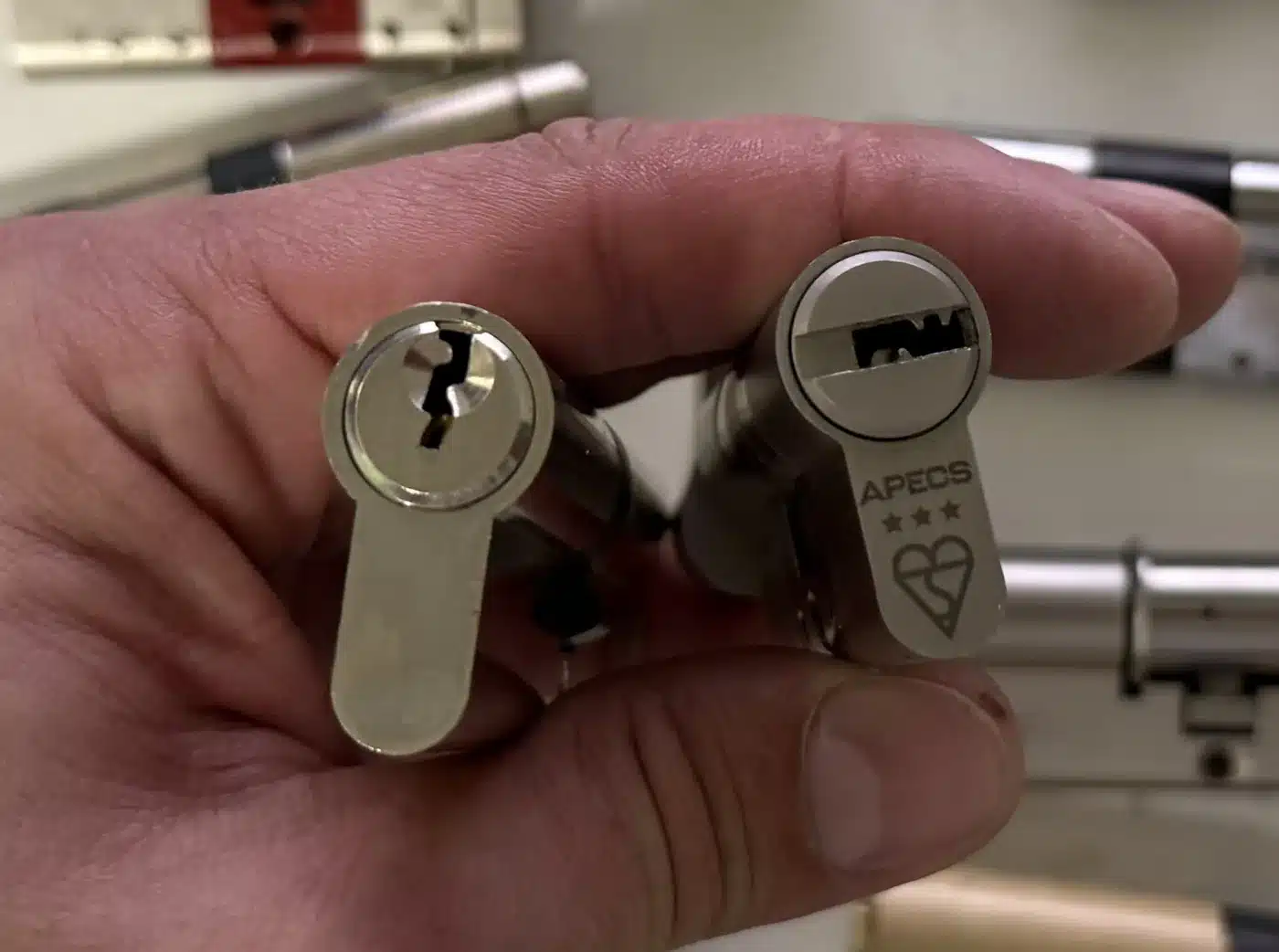
Two cylinders, one front door each. The one on the right carries three stars and the Kitemark. The one on the left carries nothing. Go and look at yours.
Now read that again, but as a homeowner
I want to be straight with you here, because this is where locksmiths usually oversell.
A good cylinder does not make your door impossible to open. I can open anything given enough time. That’s the job. What a good cylinder changes is the currency. On an unrated cylinder someone is through your door in seconds, with a tool from any hardware shop and no real skill. On a 3-star or Diamond, seconds becomes minutes, and it needs the right kit and someone who genuinely knows what they’re doing.
That sounds like a small difference. It isn’t. A burglar is shopping for seconds. Minutes means noise, means standing at your door in daylight, means the neighbour looking over. That’s the whole game. Not making your home impregnable, just making it not worth the time.
And that isn’t a sales line. It’s the advice I gave the fire service, in their own station, in front of their officer. On a good cylinder, don’t go through it. Go around it.
Here’s the part that convinces me more than anything I could say. When the anti-snap standards arrived (Sold Secure Diamond in 2011, TS007 in 2012 to 2013), recorded lock snapping fell from around a quarter of burglaries at its peak to under 10%. The standard worked. That’s not my opinion, it’s in the research, and I’ve put the numbers and the sources on my Burglary in Harrow page. If you want the detail on how snapping works and how to stop it, that’s on lock snapping.
The bit I keep thinking about
The people whose actual job is getting into locked buildings rang a locksmith to ask how it’s done.
I’m not going to pretend that makes me special. They were being thorough, and any decent locksmith could have gone down there and talked to them. But I’ll admit I was proud to be asked, and it was a genuinely good afternoon. Six people who wanted to be better at their job, asking sharp questions, for no reason other than doing it properly.
It’s my way of putting something back into Harrow. They turn up for us on the worst days of our lives. The least I can do is spend an afternoon explaining what’s inside a lock.
Not sure what’s on your front door?
If your front door still has the cylinder the builder put in, it’s very likely unrated. I’ll tell you honestly what you’ve got, and if it’s fine I’ll tell you that too and charge you nothing for looking.